
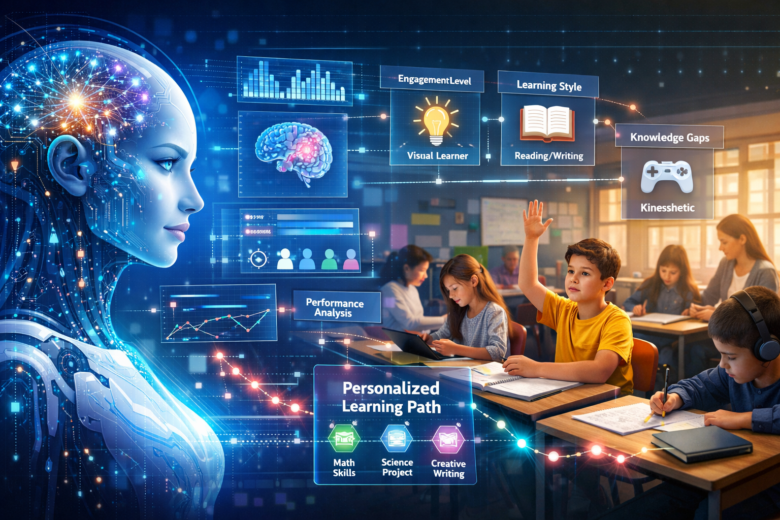
Intelligent systems are changing education by not depending on rigid models of teaching. Cognitive Digital Twins (CDTs) are one of the most developed AI-driven simulations representing how individual students think, learn, and adapt. Such online models are continuously evolving, allowing moving beyond the generalized education to highly personalized and anticipatory learning experiences.
What are Cognitive Digital Twins in Education?
Cognitive Digital Twins are interactive AI programs that mimic cognitive behaviors in a learner such as the manner in which they process information, how they react to problems, knowledge retention and their engagement. In contrast to the conventional analytics tools that use the previous data, CDTs constantly learn and update themselves through the interactions in real time.
These systems construct a model of thinking about each student, and educators and platforms can understand not only what a student knows, but their learning preferences. This renders education more adaptive, efficient and individual potential.
The way Cognitive Digital Twins work.
Data Recording and Data Tracking.
The initial step of Cognitive Digital Twins is to gather rich data of student interactions, including quiz answers, tasks duration, engagement rates, and even emotional cues. This information is the basis of the learning behavior of individuals. With time, the system will determine the patterns that a student will use in learning tasks.
AI-Based Cognitive Modeling
The system converts the raw data into an organized cognitive model using machine learning algorithms. This model is used to simulate the way the student processes information, problem solving and response towards new information. It turns into an electronic image of the way of thinking of the student.
Ongoing Education and Change.
The digital twin of students develops as they keep engaging with the learning systems. The model is self-refining; it compares predictions with real results, and guarantees their growing accuracy. This feedback system enables the system to be aligned to the growth of the student.
Predictive Personalization
Among the strongest points of CDTs is the ability to forecast the future learning requirements. The system is able to predict challenges, suggest content and modify the learning paths in advance to make the educational process more comfortable and productive.
The main advantages of Cognitive Digital Twins.
- Hyper-Personalized Learning: Adapts content to the learning style and speed of individual students.
- Early Learning Gap Detection: Before it becomes a big problem, detect challenges.
- Enhanced Interaction: Coordinates learning and student interests and tendencies.
- Adaptive Assessments: The emphasis is shifted to continuous assessment as opposed to the fixed exams.
- Improved Teaching Feedback: Gives teachers real time and actionable feedback.
Uses in Current Education.
Personalized AI Tutors
Cognitive Digital Twins allow AI tutors to do more than merely providing answers to questions- they can have an idea of how a student thinks. This enables them to describe ideas in a manner that is comprehensible to the learner considering his/her thinking style and therefore understanding and remembering it better.
Curriculum Optimization
Through collective cognitive patterns, institutions are able to come up with more flexible and effective curricula. This guarantees that the forms of teaching are in tandem with the way students learn and not based on old standardized ways of learning.
Career Path Guidance
CDTs are also able to monitor the long-term learning behaviour and skill development and assist the students in finding career paths that suit their interests and abilities. This leads to better educated and confident education-employment transition.
Special Education Support
CDTs are very advantageous to students with learning differences because such systems have the ability to accommodate individual cognitive requirements. Individualized interventions make sure that each learner gets the help he/she needs to be successful.
Difficulties and Ethical Iss.
Data Security and Data Privacy.
Because CDTs are based on personal data in great numbers, and privacy, and safety are paramount concerns. Learning institutions need to put in place robust measures to curb abuse or violations.
Bias in AI Systems
Unless the training data is not biased, the digital twin can generate unjust or inaccurate insights. Developers should also make sure that the AI models are non-discriminatory and non-biased to promote fairness.
Technological Dependency
The excessive use of AI systems might decrease human engagement in learning. It is necessary to have a balance between human direction and technology.
Cost and Accessibility
Application of CDT systems needs infrastructure and skills. The formulation of equal access to various regions and institutions is still a key challenge.
Enhanced Benefits of Cognitive Digital Twins.
- Precision Learning Delivery: Provides content with accuracy at the appropriate time to that learner.
- Continuous Skill Tracking: Measures improvement without necessarily using examinations.
- Dropout Prevention: Identifies early signs of disengagement and initiates early action.
- Smart Academic Planning: Helps students to select subjects and skills in a strategic manner.
- Scalable Personalization: Helps institutions to provide individualized education at scale.
Future of Cognitive Digital Twins in Education
Adoption of Emerging Technologies.

Cognitive Digital Twins will be more and more combined with other technologies such as augmented reality, virtual reality, or neurotechnology. This will produce the immersive learning environments where the learning process can be not only personalized but also experiential and interactive.
Learning Systems that are Emotionally Intelligent.
The next generation of CDTs will not only have cognitive modeling but also emotional intelligence. These systems will develop more accommodating and interactive learning environments by being aware of the emotions of the students.
Learning companions throughout life.
CDTs can become lifelong companions who can help people learn, develop a career and improve their skills constantly. This will transform learning into an ongoing process and not a restricted stage.
Conclusion
Cognitive Digital Twins can be considered a significant step toward the realm of actually personalized education. Through copying the way students think, learn and evolve, these systems allow them to have a proactive, adaptive, and highly efficient learning process. Though issues like privacy, prejudice, and availability have to be considered, the possibilities of CDTs to revolutionize education are enormous. Cognitive Digital Twins are poised to be one of the foundations of future learning ecosystems as technology keeps progressing.
Frequently Asked Questions (FAQs)
1. What is the benefit of Cognitive Digital Twins to student performance?
They offer learning tracks and early intervention, which is individualized and assists students to get over obstacles fast.
2. Do Cognitive Digital Twins apply to higher education?
No, they can be implemented at all levels, starting with primary school, up to the professional training.
3. What are the technologies behind Cognitive Digital Twins?
They are based on AI, machine learning, data analytics, and even IoT and wearable technologies.
4. Do students have control over their data of the digital twin?
Preferably, students would be allowed to control their data, which would be based on platform policies and regulations.
5. How do CDTs affect education in the long-term perspective?
They will transform the conventional education paradigms into wholly individualized and flexible learning systems.