
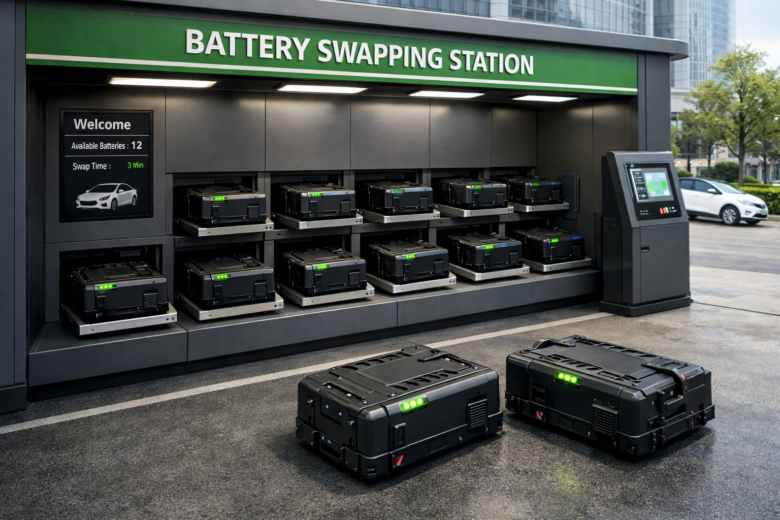
Electric Vehicles (EVs) are fast becoming popular in India and the world. Nevertheless, there is a significant issue that users continue to struggle with and it is a long charging time. It is here that battery swapping technology comes in as a very potent solution. Rather than having to wait hours to recharge a battery, users can just replace a depleted battery with a fully charged one in minutes. This method will save time as well as enhance the overall usage of the vehicles, particularly to commercial users who may need day-long operations.
What is Battery Swapping Technology?
Battery swapping is a practice in which an EV battery is not fixed but can be removed. Once the battery is depleted a user can go to a swapping station and see where he can change the battery to a fully charged one. The whole procedure is generally only 2-5 minutes, far quicker than the conventional EV charging.
Simply put, it involves substituting an empty LPG cylinder with a filled one. The idea revolves around convenience, speed, and efficiency. It also does away with the necessity of spending much time in line and makes the use of EVs more viable to both the everyday commuter and businesses that require quick turnaround times.
How Battery Swapping Works
Battery-as-a-Service (BaaS) Model
In this model, users do not own the battery. Instead, they get on a subscription and make use of batteries that are supplied by swap stations. This helps a great deal to lower the initial cost of the car and eliminates the hassle of maintaining the batteries.
Also, the BaaS model can be used to pay only on the usage and is a flexible and cost-effective solution. It also makes sure that the users will always receive a well-kept battery as service providers will consistently monitor performance, safety, and efficiency.
Swapping Station Network
Swapping stations (network) are set up in cities with easy exchange of batteries by the users. The setup of these stations could be automated or manually controlled.
With the growth of the network, it becomes more accessible, and users will not have problems locating nearby stations. This will even be made easier in the future by mobile applications and intelligent navigation systems that can direct users to the closest available swapping station in real time.
Benefits of Battery Swapping
Fast Refueling Experience
The battery changing experience is like a petrol station. Without charging, users are able to be back on the road within minutes.
It is especially helpful among individuals who use their vehicles in high frequency like delivery riders, taxi drivers and logistics operators. Less downtime will directly translate to increased productivity and improved earnings.
Lower Initial Cost
The initial price of EVs is comparatively low due to the fact that the battery is not part of the purchase of the vehicle.
This low cost can prompt more individuals to make the transition to electric vehicles, particularly in the price elastic markets. It also provides the business with a chance to use EVs without significant investments.
Challenges of Battery Swapping
Standardization Issues
Various manufacturers adopt various designs of batteries; therefore, it is challenging to develop a universal swapping system.
Lack of standardization may confine the user to a particular brand or network, which is inflexible. This problem needs to be overcome by industry-wide cooperation and create a smooth ecosystem.
High Infrastructure Cost
Installation and operation of swapping stations are costly, particularly at the initial phases.
The cost is in terms of not just physical infrastructure but also the inventory of batteries, software systems and maintenance operations. Nonetheless, with continued adoption, these costs can be lowered with the assistance of the economics of scale with time.
Battery Swapping in India: Growth & Adoption
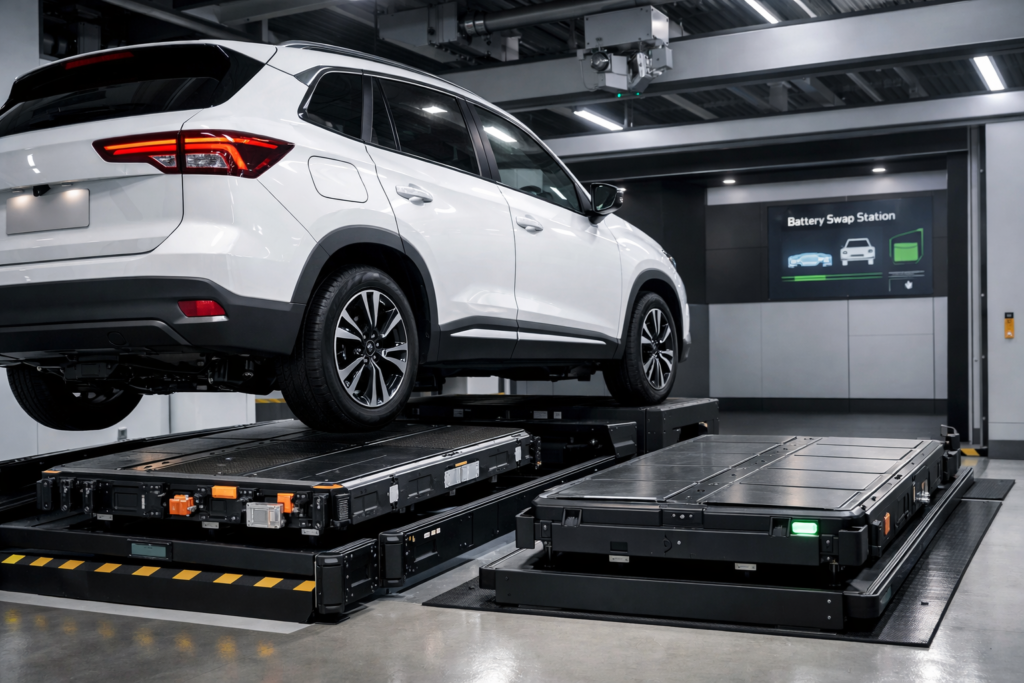
India is aggressively encouraging battery swapping with government programs, and private investments. This is aimed at fast-tracking the adoption of EV technology and decreasing the use of conventional fuels.
SUN Mobility and Battery Smart companies are on the forefront in swapping infrastructure development. These firms are fast gaining momentum in large cities and are also looking into the small towns.
Future Trends
The battery swapping technology shall be instrumental in mobility in future. The swapping ecosystem will evolve further and be more efficient as EV uptake continues to increase. Its capabilities will also be enhanced with innovations in automation, artificial intelligence, and integration of renewable energy.
We can expect fully automated swapping stations in the years to come where the user does not even have to get out of his/her car. The system will also be more sustainable and environmentally friendly with integration with smart grids and renewable sources of energy. With the changing of technology, swapping of the battery might become as easy as going to gas stations.
Key Future Developments
- Invention of intelligent and completely automated swapping stations.
- Use of AI for real-time battery health monitoring
- Acquisition of tier-2 and tier-3 cities.
- Combination with clean energy sources such as solar energy.
- Standardization of battery systems throughout industry.
- Widespread implementations in fleet and commercial vehicles.
Conclusion.
Battery swapping technology has the potential to revolutionize the EV ecosystem. It saves a lot of time on charging, saves money on vehicles and enhances user convenience. Although some challenges continue like standardization and development of infrastructure, continuous innovations and support of the policy are overcoming those hurdles.
Battery swapping is bound to become a standard solution as additional companies invest in the field and governments implement enabling policies. It can be instrumental in the long-term to make electric mobility more viable, efficient, and accessible to all.
Frequently Asked Questions (FAQs).
Q1. Is battery swapping safe?
Yes, battery replacement is safe in case the service providers follow the standards and maintenance practices.
Q2. What is the battery swapping time?
Typical battery changes require approximately 2-5 minutes.
Q3. Is it possible to use battery swapping in all EVs?
No, just EVs that have removable batteries can have swapping systems.
Q4. Is charging more expensive than battery swapping?
It may also be cheaper in the long-run in most instances as users do not have to buy the battery.
Q5. What does the future of battery swapping have in India?
The future is bright particularly in the case of commercial vehicles and delivery services where efficiency is of paramount importance.